Service Dog Tasks and the Public Access Test, Explained
This page explains the law in general terms. It is not legal advice. For a specific situation, contact the agency listed on this site or an attorney.
Two ideas come up again and again when people plan to train a service dog in Kentucky. The first is the work the dog does, called tasks. The second is the public access test, a benchmark for how the dog behaves in public.
They are related, but they are not the same thing, and neither one is a certificate. This guide walks through both, step by step, so you can build a clear training plan and know where the law starts and stops.
The short version
- Under the ADA, a service animal is a dog individually trained to do work or perform tasks for a person with a disability (ADA.gov, Service Animals FAQs).
- A task is specific work that is directly related to the person's disability. Being present and comforting is not a task by itself.
- The public access test is a training benchmark used by Assistance Dogs International (ADI) programs. The ADA does not require a dog to pass it.
- There is no official service dog registry or required certification under the ADA.
What you need before you start
You do not need much equipment. Gather these first:
- A dog with a steady, friendly temperament and good health. Your veterinarian can help you judge whether your dog is physically suited to the work.
- Small, soft, high-value treats, plus the dog's regular food for lower-stakes practice.
- A flat collar or a well-fitted harness and a standard leash. Humane, reward-based gear only.
- A notebook or phone notes to log each task, the date, the setting and how it went.
- A patient helper who can act as a stranger, a shopper or a server during practice.
- A written list of the disability-related needs you want the dog to help with.
A vest is not required by the ADA. Gear does not make a dog a service dog. Training does.
Step 1: Understand what counts as a task
The ADA.gov Service Animals FAQs define a service animal as a dog that is individually trained to do work or perform tasks for an individual with a disability. The work or task has to be directly related to the person's disability.
That wording matters. A task is something the dog does on cue or in response to a specific sign, and you could teach it to another dog in the same way. Common examples, grouped by disability, include:
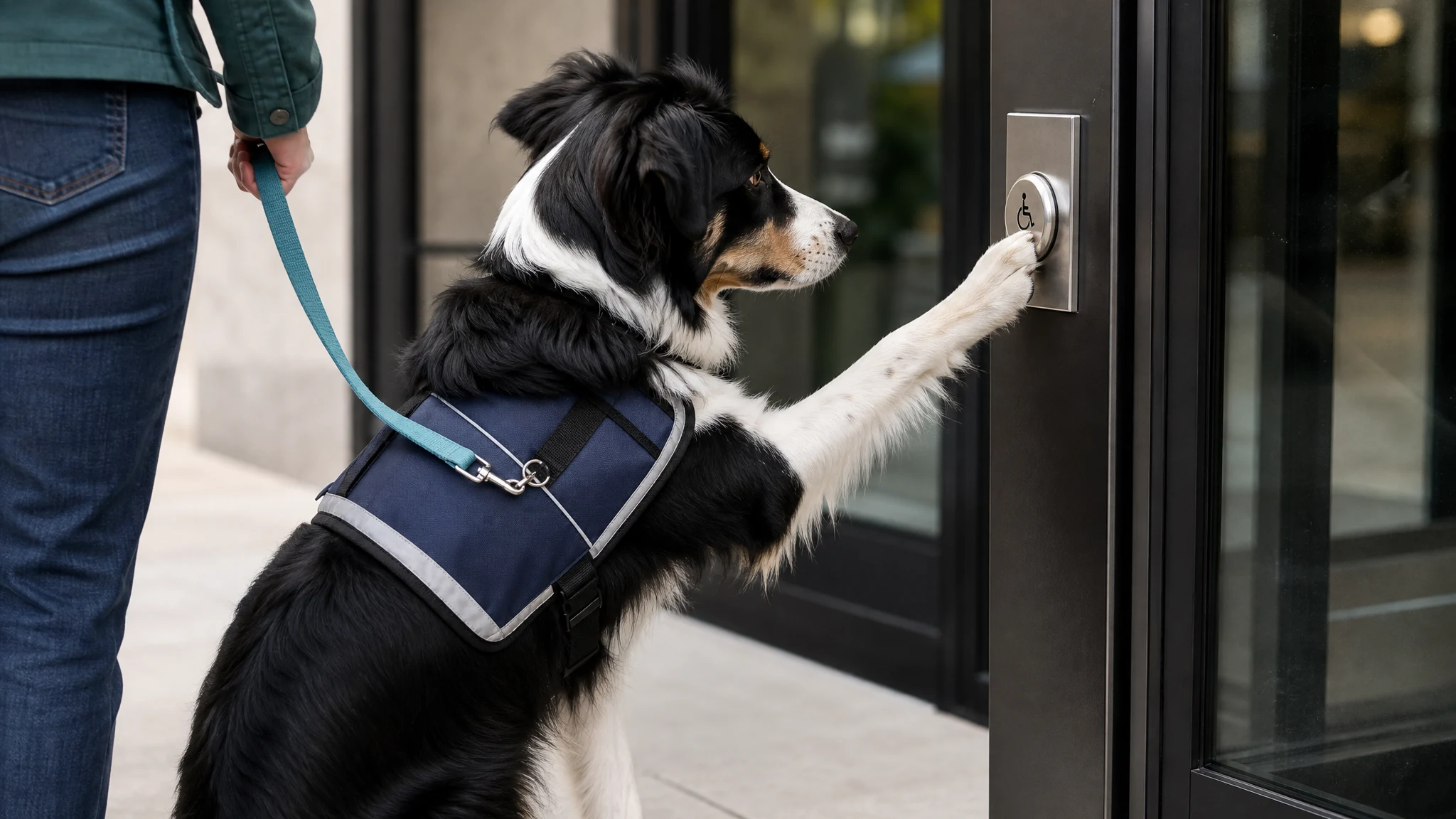
- Mobility disabilities: retrieving dropped items, opening and closing doors, pulling a manual wheelchair, bracing so the handler can stand, or turning light switches on and off.
- Hearing loss: alerting the handler to a doorbell, an alarm, a name being called or an approaching person.
- Vision loss: guiding around obstacles, stopping at curbs and stairs, and finding doors or elevators.
- Diabetes or seizure conditions: alerting to a change the dog has been trained to notice, fetching help or a medical kit, or staying with the handler during an event.
- Psychiatric conditions such as PTSD: interrupting repetitive behaviors, turning on lights in a room, creating space in a crowd by standing in front of or behind the handler, or waking the handler from a nightmare.
- Autism: interrupting repetitive behavior, blocking or steadying in a crowd, or helping a person stay with a caregiver.
These are examples, not a complete or approved list. If you are wondering what tasks a service dog can do, the honest answer is any trained task that is directly tied to your disability. A trainer or your health care provider can help you shape a list that fits your needs.
Step 2: Separate tasks from comfort
Many people ask where the line sits between a service dog and an emotional support animal. The ADA draws it clearly. Emotional support, therapy and comfort animals are not service animals under the ADA.
The reason is the definition. A dog whose only role is to be near someone and provide comfort is not trained to perform a specific task. A dog that senses a panic attack starting and has been trained to nudge, lean or interrupt in response is doing trained work. That is the difference.
Kentucky follows the same split in public places. The state statute on assistance dogs, KRS 258.500, uses the term "assistance dog" and does not give emotional support animals public access. Housing is handled separately under KRS 383.085, which lets a person with a disability request a reasonable accommodation to keep an assistance animal in a dwelling.
Step 3: Pick tasks and write them down
- List the situations where your disability makes daily life harder.
- For each one, ask what a dog could physically do that would reduce the difficulty.
- Choose two or three tasks to start. More can come later.
- Write each task as a short sentence: the cue or trigger, the action, and the result.
For example: "When I drop my keys, the dog picks them up and places them in my hand." A written description helps you train consistently. It also gives you a clear answer if someone asks what the dog is trained to do.
Step 4: Teach each task with rewards
Use humane, reward-based training, in line with the American Veterinary Society of Animal Behavior (AVSAB). That means rewarding the behavior you want and setting the dog up to succeed. It does not include shock, prong or choke collars, alpha rolls, scruffing or dominance methods.
- Break the task into tiny pieces. To teach a retrieve, reward the dog first for looking at the item, then for touching it, then for picking it up.
- Add a cue. Once the dog offers the behavior reliably, attach a word or signal.
- Add the trigger. For an alert task, pair the real sound or sign with the behavior until the dog responds on its own.
- Add distance, time and distraction one at a time. Change only one variable per session.
- Practice in new places. A task that works in the living room may fall apart in a parking lot.
Keep sessions short and end on a success. Log what you practice so you can see where the dog is steady and where it is not.
Step 5: Learn what the public access test is
The service dog public access test is a standardized way to check how a dog handles being out in the community. Assistance Dogs International (ADI), an association of assistance dog programs, uses a public access standard as part of how its member programs evaluate dogs and handlers.
It is helpful to think of it as a training benchmark. It is not a law and not a license. The ADA does not require a service dog to pass any public access test, and no test result is a legal document.
Why use it, then? Because the skills it checks are the ones that keep you, the dog and the public safe. Programs such as Paws With Purpose in Louisville describe themselves as ADI accredited, so you may see this kind of evaluation in accredited training. For the exact current test items and scoring, check with ADI or with the program you are working with, since this guide does not reproduce the official form.
Step 6: Build the public behaviors behind the test
Whatever test you use, the skills tend to fall into the same groups. Treat the list below as a practice plan, not as the official test.
- Calm and controlled around people. The dog stays beside you while others walk past, speak or reach out.
- Loose-leash walking. No pulling or lunging through doors, aisles or crowds.
- Settle on the floor. The dog lies quietly under a table or beside a chair for a long stretch.
- Ignoring food and distractions. Dropped food, other dogs and noises do not pull the dog away from you.
- Staying put on cue. The dog waits through a door, an elevator ride or a checkout line.
- Toileting on cue and keeping clean. The dog relieves itself only when and where you ask.
- Handling transport and tight spaces. The dog rides in vehicles, and fits in aisles and waiting rooms without fuss.
- Staying focused on you. The dog does not bark, sniff merchandise or greet strangers uninvited.
Work up gradually. Start in a quiet hardware store aisle or a parking lot, then move to busier places once the dog stays relaxed.
Step 7: Practice a mock test with a helper
- Pick a location where dogs are allowed and you have permission to practice.
- Ask your helper to play the stranger, the server or the passerby.
- Go through each skill from Step 6 in order, without extra cues or treats you would not use in real life.
- Note every slip: a lunge, a sniff, a bark, a stall at the door.
- Return to the weakest skill and train it at an easier level before trying the full run again.
If you work with a professional trainer or an ADI-accredited program, ask whether they can run a formal evaluation. An outside observer often spots things you stop noticing.
What Kentucky law adds
Federal law sets the baseline, and Kentucky adds its own rules. According to the statutes, in Kentucky:
- Under KRS 258.500, a person with an assistance dog may not be denied access to hotels, motels, restaurants or other eating establishments, and is entitled to full and equal accommodations on all public transportation without an extra fare.
- Those rights are tied to conditions such as the dog being vaccinated, tagged and under the handler's control.
- The statute's definition of "person" also covers a trainer of an assistance dog. A trainer accompanied by an assistance dog must carry identification verifying that they are an assistance dog trainer. The statute text this guide relied on did not spell out rules for dogs in training such as age or gear, so check with the Kentucky Commission on Human Rights before you take a dog in training into a business.
- Under KRS 258.991, misrepresenting a dog as an assistance dog to gain accommodation is a violation punishable by a fine of up to $1,000. Housing misrepresentation, including fitting a non-assistance animal with a harness, collar, vest or sign, carries a fine of up to $1,000 under KRS 383.085.
Staff at a business may ask only two questions under the ADA: whether the dog is a service animal required because of a disability, and what work or task the dog has been trained to perform. That is why a clear, simple answer about your dog's tasks is useful. Staff may not ask for proof of a registration or certificate, because none is required.
For more on Kentucky programs, laws and costs, see our guide to service dog training in Kentucky.
Tips for steadier training
- Train tasks and public manners side by side. A dog that can retrieve at home but cannot settle in a shop will struggle in daily life.
- Keep notes. A log of dates, places and results shows you where progress is real.
- Proof one skill at a time. If the dog fails in a new setting, go back to an easier setting rather than repeating the failure.
- Watch the dog's stress signals, such as panting, yawning and avoiding eye contact. Take a break before the dog gets overwhelmed.
- Retire gracefully. If a dog does not enjoy the work, stopping is a kind and responsible decision.
Common mistakes to avoid
- Treating comfort as a task. A dog that simply makes you feel better is valuable, but it is not a service dog under the ADA unless it is trained to do specific work.
- Buying a registration or ID. There is no official registry or required certification under the ADA. An online registration is not legal proof, so skip those sellers.
- Assuming the test is a legal requirement. It is a benchmark. Passing it does not create rights, and not taking it does not remove them.
- Using harsh tools. Shock, prong and choke collars and dominance methods can raise fear and stress, and they do not fit current behavior guidance.
- Rushing into crowded places. Early bad experiences can set training back for weeks.
- Skipping vet checks. Pain, poor hearing or poor eyesight can look like disobedience.
What results to expect
Training a dog for tasks and public settings usually takes a long time, often many months and sometimes longer. Results vary with the dog's temperament, the complexity of the task, the handler's consistency and the training setting.
With steady, reward-based practice, many teams find that the dog becomes more reliable at its tasks and calmer in public. Some dogs may still turn out not to suit the work, and that is a normal part of the process. No method can promise a particular outcome.
If you are turned away or treated unfairly
This article states the law in plain terms and is not legal advice. If you believe a business or landlord in Kentucky has wrongly denied you access, you can contact the Kentucky Commission on Human Rights at 312 Whittington Parkway, Suite 020, Louisville, KY 40222, phone (502) 595-4024, or by email at [email protected].